Subclass 189 Skilled Independent visa
This visa is for invited workers, eligible New Zealand citizens and eligible Hong Kong or British National (Overseas) passport holders with skills that Australia needs, to live and work permanently anywhere in Australia.
This Visa Subclass currently 2 Streams as outlined below ( The Skilled Independent (subclass 189) (New Zealand stream) visa permanently closed to new applications on 1 July 2023. )
Points tested stream
- You don't need a sponsor or nominator but do have an occupation on the relevant skilled occupation list
- You must submit a Expression of Interest (EOI)
- have a suitable skills assessment for the occupation
- you must have at least competent English.
- Meet Health and Character requirement
- satisfy the points test ( Minimum points 65)
- You must be invited to apply
- You must be under 45 to be invited
To calculate how many points you may score use the points calculator.
New Zealand stream
The Skilled Independent (subclass 189) (New Zealand stream) visa permanently closed to new applications on 1 July 2023. )
Hong Kong stream
This visa lets eligible Hong Kong or British National (Overseas) passport holders who have demonstrated commitment to Australia, live and work in Australia permanently.
- You must hold a Hong Kong passport or a British National (Overseas) passport
- You must meet certain visa requirements
- You must meet certain residence requirements
You must hold an eligible visa at the time your visa application is made, and you must have held that visa for at least 4 years prior to that date. Multiple visas, including visas of the same subclass, cannot be combined to meet this requirement.
An eligible visa is a subclass 457, 482 or 485 visa that was granted to you on the basis of satisfying the primary criteria.
- If your eligible visa was granted before 9 July 2020
- Your visa must not expire after 8 July 2025.
- If your eligible visa was granted on or after 9 July 2020
- Your visa must be valid for 5 years.
Proposed Four-Tier Occupation System for Skilled Independent (Subclass 189) Visa
Outlines for a reform package for the 189 program and introduction of a four-tier occupation structure that ranks occupations by priority.
December 2025
A recently released Freedom of Information (FOI) document provides insight into how the Department of Home Affairs may be managing Skilled Independent (subclass 189) invitation rounds. Dated May 2025, the internal Meeting Minute outlines a reform package for the 189 program and introduces a four-tier occupation structure that ranks occupations by priority.
While this tier system has not been publicly published or formally announced, recent 189 invitation patterns closely align with the proposals in the Minute. The document appears to have been endorsed by the Director of Independent Skills, Talent and Business before the start of the 2025–26 program year, suggesting the tier structure is already influencing invitation outcomes.
How the Tier System Works
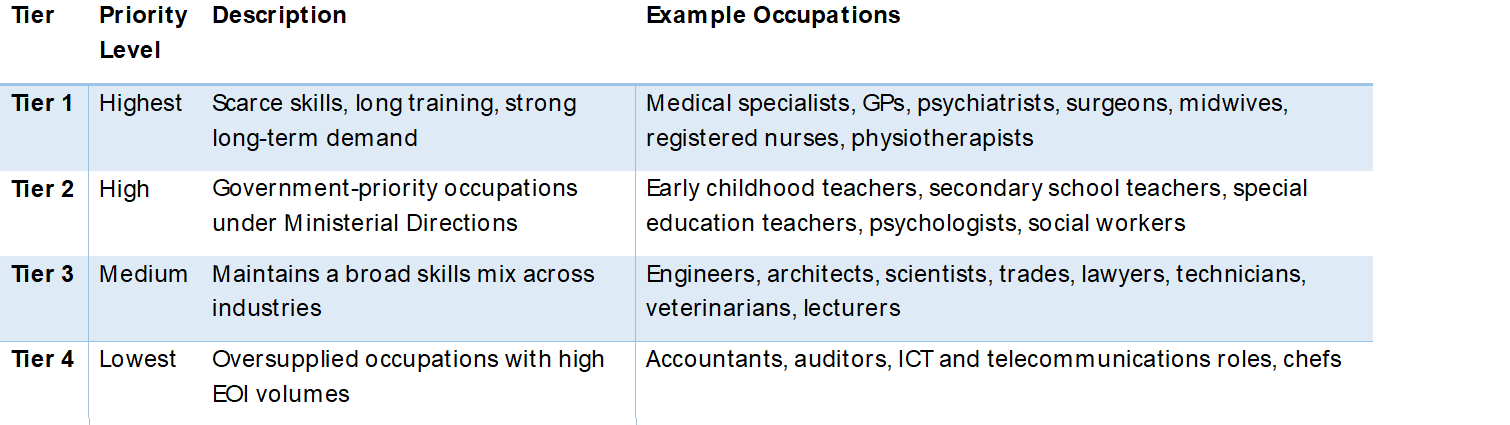
According to the FOI document, all eligible skilled occupations are divided into four tiers:
Tier 1 – Highest Priority
Characteristics: Scarce skills, long training periods, strong long-term demand
Example occupations: Medical specialists, GPs, psychiatrists, surgeons, midwives, registered nurses, physiotherapists
Tier 2 – High Priority
Characteristics: Government-priority occupations under Ministerial Directions
Example occupations: Early childhood teachers, secondary teachers, special education teachers, psychologists, social workers
Tier 3 – Medium Priority
Characteristics: Maintains a broad skills mix across industries
Example occupations: Engineers, architects, scientists, trades, lawyers, technicians, veterinarians, lecturers
Tier 4 – Lowest Priority
Characteristics: Oversupplied occupations with high EOI volumes
Example occupations: Accountants, auditors, ICT and telecommunications roles, chefs
Why This Matters for Migration Planning
The tier system provides valuable insight into invitation outcomes:
Occupations in Tier 1 or 2 often receive invitations at lower points, reflecting their higher priority.
Occupations in Tier 4 face smaller occupation ceilings and fewer invitations, meaning applicants may wait longer despite having strong points.
For example, chefs, ICT professionals, and accountants are generally Tier 4 occupations. For these applicants, relying solely on the 189 program may be less predictable. In such cases, employer-sponsored pathways like the Skills in Demand (subclass 482) or the Employer Nomination Scheme (subclass 186) visas can provide a more reliable route to permanent residency.
Other Key Reforms Highlighted in the FOI Document
The FOI Minute also proposes several changes to make SkillSelect more structured and responsive:
- More Frequent and Predictable Invitation Rounds
The Department aims for a quarterly schedule, with flexibility for additional rounds to reduce waiting times and address urgent skill shortages. - Greater Public Transparency
Clearer communication on invitation timing, program priorities, and the selection process will help reduce uncertainty for applicants and encourage high-value EOIs. - Recalibrated Occupation Ceilings
Occupation ceilings will use new multipliers for each tier and consider grants across all skilled programs (subclasses 186, 190, 491) before 189 invitations are issued. - Earlier Identification of Priority Skills
SkillSelect data will be used to identify emerging labour market needs, allowing the Department to adjust invitations while maintaining diversity through Tier 3.
Takeaway
While the tier system is an internal planning tool, not legislation, it offers a practical view of how the Department prioritises occupations in the Skilled Independent program. Understanding this structure helps applicants and employers plan realistic pathways to permanent residency and make informed decisions about whether to pursue independent or employer-sponsored visas
Proposed Tier system